Example: Blink
A simple example of blinking an LED on and off using the wiring-x86 interface.
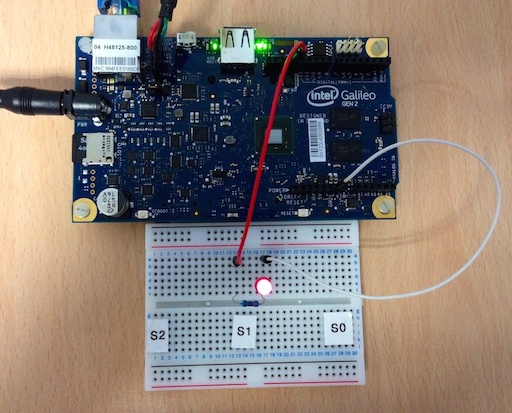
# -*- coding: utf-8 -*-
#
# Copyright © 2014, Emutex Ltd.
# All rights reserved.
# http://www.emutex.com
#
# Author: Nicolás Pernas Maradei <nicolas.pernas.maradei@emutex.com>
#
# See license in LICENSE.txt file.
#
# This example is inspired on Arduino Blink example.
# http://arduino.cc/en/Tutorial/Blink
#
# This example will work "out of the box" on an Intel® Edison board. If
# you are using a different board such as an Intel® Galileo Gen2, just change the
# import below. wiringx86 uses the same API for all the boards it supports.

# Import the time module enable sleeps between turning the led on and off.
import time

# Import the GPIOEdison class from the wiringx86 module.
from wiringx86 import GPIOEdison as GPIO

# Create a new instance of the GPIOEdison class.
# Setting debug=True gives information about the interaction with sysfs.
gpio = GPIO(debug=False)
pin = 13
state = gpio.HIGH

# Set pin 13 to be used as an output GPIO pin.
print 'Setting up pin %d' % pin
gpio.pinMode(pin, gpio.OUTPUT)

print 'Blinking pin %d now...' % pin
try:
    while(True):
        # Write a state to the pin. ON or OFF.
        gpio.digitalWrite(pin, state)

        # Toggle the state.
        state = gpio.LOW if state == gpio.HIGH else gpio.HIGH

        # Sleep for a while.
        time.sleep(0.5)

# When you get tired of seeing the led blinking kill the loop with Ctrl-C.
except KeyboardInterrupt:
    # Leave the led turned off.
    print '\nCleaning up...'
    gpio.digitalWrite(pin, gpio.LOW)

    # Do a general cleanup. Calling this function is not mandatory.
    gpio.cleanup()